The Motorola Razr Fold resurrects one of the most iconic phone names in mobile history, wrapping it in cutting-edge foldable technology. But can sentimental value and sleek design justify a price tag that rivals flagship smartphones? After extensive testing, this Motorola Razr Fold review reveals whether this vertical flip phone delivers the premium experience modern buyers expect or simply trades on brand recognition.
The foldable phone market has matured considerably, with Samsung dominating the space and newcomers like OnePlus pushing innovation forward. Motorola hopes its legendary RAZR heritage will give it an edge in a crowded field where hardware specs and real-world usability matter more than nostalgia.
What Is the Motorola Razr Fold?
The Motorola Razr Fold represents Motorola’s premium entry into the vertical foldable smartphone category. Unlike traditional candy-bar phones or the horizontal book-style folds like Samsung’s Galaxy Z Fold series, this device flips vertically, folding in half to create a compact square that slips easily into pockets.
This design connects directly to the legendary Motorola RAZR V3 from 2004, which sold over 130 million units and became a cultural phenomenon. The modern Razr Fold borrows that flip-phone DNA while incorporating a flexible OLED display and contemporary Android capabilities.
Motorola positions this device as a fashion-forward flagship for users who value portability and style alongside performance. The target audience includes professionals wanting a full-sized phone that becomes pocket-sized, fashion-conscious buyers drawn to unique designs, and anyone nostalgic for the satisfying snap of closing a flip phone.
The Razr Fold competes directly with Samsung’s Galaxy Z Flip 5, which has dominated the vertical foldable market. Motorola differentiates itself through design choices, software customization, and price positioning that attempts to undercut Samsung while maintaining flagship credentials.
Design and Build Quality: Does the Retro Appeal Hold Up?
The Motorola Razr Fold feels immediately premium when you pick it up. The device uses an aluminum frame with Gorilla Glass Victus on the outer display, creating a solid, substantial feel that justifies its flagship status. When unfolded, it measures 6.9 inches tall and weighs 188 grams, making it lighter than many traditional flagship phones.
The hinge mechanism represents the engineering centerpiece. Motorola employs a teardrop-style hinge that creates less stress on the folding display compared to earlier foldable designs. The hinge operates smoothly through its full range of motion and holds firm at any angle between 30 and 150 degrees, enabling hands-free video calls and creative photography angles.
Durability remains a legitimate concern with any foldable. Motorola rates the hinge for 200,000 folds, which translates to roughly five years of opening and closing the phone 100 times daily. The hinge feels robust during testing, with no wobble or looseness even after thousands of folds. Water resistance carries an IP52 rating, protecting against light splashes but not full submersion.
The aesthetic nods to the original RAZR are subtle but present. The chin of the device when unfolded echoes the proportions of the 2004 model, and the overall industrial design language maintains that clean, minimalist approach Motorola pioneered two decades ago.
Pocket-ability represents one of the Razr Fold’s strongest advantages. Folded, it becomes a 3.5-inch square that disappears into jean pockets, purses, or jacket pockets without the awkward bulge of traditional smartphones. Compared to Samsung’s Z Flip 5, the Razr Fold is slightly thinner when folded but marginally wider.
Display Performance: Outer vs. Inner Screens
The Motorola Razr Fold features two distinct displays, each serving different purposes. The outer cover display measures 3.6 inches with a 144Hz refresh rate and 1066 x 1056 resolution. This screen handles quick tasks without opening the phone: checking notifications, controlling music, taking selfies, and running specially optimized widgets.
Motorola deserves credit for making the outer display genuinely functional. You can run full Android apps on this external screen, though some apps display awkwardly due to the nearly-square aspect ratio. The 144Hz refresh rate makes scrolling through notifications feel exceptionally smooth.
The inner foldable display opens to reveal a 6.9-inch pOLED panel with 2640 x 1080 resolution and a 144Hz adaptive refresh rate. Colors appear vibrant with excellent saturation, and brightness peaks at approximately 1000 nits, making outdoor visibility acceptable even in direct sunlight.
The crease remains visible on the Razr Fold, particularly when light hits the screen at certain angles. Running your finger down the center of the display, you feel a slight valley where the screen folds. This crease is less pronounced than earlier foldable generations but more noticeable than Samsung’s latest Z Flip 5.
Real-world viewing experience proves excellent for multimedia consumption. Watching videos on YouTube or streaming services takes advantage of the tall aspect ratio, and the 144Hz refresh rate makes gaming and scrolling through social media feel responsive and fluid. The only limitation is the relatively narrow width, which can make some content feel cramped compared to traditional 16:9 displays.
Camera System: Specs vs. Real-World Performance
The Motorola Razr Fold equips a dual-camera system on the exterior: a 50-megapixel main sensor with f/1.5 aperture and optical image stabilization, paired with a 13-megapixel ultrawide camera with f/2.2 aperture and 120-degree field of view. The inner display houses a 32-megapixel selfie camera.
Photo quality from the main sensor impresses in good lighting conditions. Images show accurate colors, strong dynamic range, and sharp detail. The f/1.5 aperture gathers plenty of light, and the optical stabilization helps maintain sharpness in slightly challenging conditions.
Low-light performance represents a mixed result. The Night Mode improves darker scenes considerably, brightening shadows and controlling highlights effectively, but images often show more noise than competing flagship phones from Samsung or Google, with processing taking several seconds to complete.
The ultrawide camera delivers acceptable results but shows visible quality degradation compared to the main sensor. Edge distortion appears more pronounced than premium competitors, and detail suffers in anything less than ideal lighting.
Video recording maxes out at 4K resolution and 60 frames per second. Footage looks stable thanks to electronic and optical stabilization working together, and autofocus tracks subjects reliably. The quality suits most social media and personal recording needs, though it trails dedicated video-focused phones.
Zoom capabilities rely entirely on digital cropping since neither camera offers telephoto optics. Results at 2x zoom remain usable, but anything beyond that shows significant quality loss. This represents one area where the Razr Fold clearly compromises compared to traditional flagship phones.
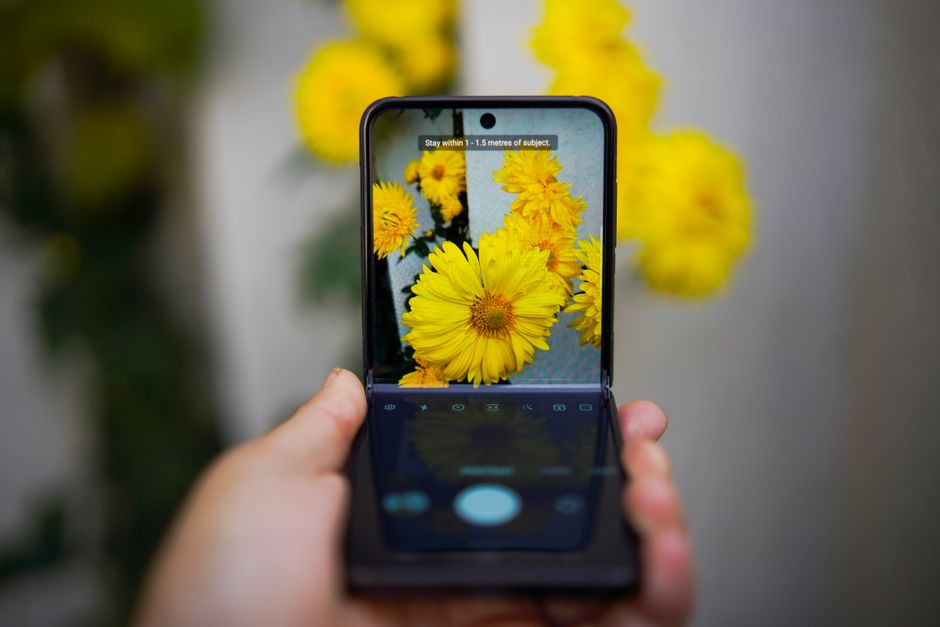
The unique advantage comes from using the outer display as a viewfinder with the main cameras for selfies. This delivers dramatically better self-portraits than any front-facing camera could achieve, making the Razr Fold exceptional for vloggers and selfie enthusiasts.
Performance and Software: Speed and User Experience
Motorola powers the Razr Fold with the Snapdragon 8+ Gen 1 processor paired with 8GB of RAM and 256GB of non-expandable storage. This chipset represents a step down from the absolute latest Snapdragon 8 Gen 2 found in current premium flagships, though real-world performance remains excellent for virtually all tasks.
Multitasking handles smoothly with apps staying resident in memory and switching between them happening instantaneously. Gaming performance proves capable, running demanding titles like Genshin Impact at high settings with only occasional frame drops during intense scenes. The phone generates noticeable heat during extended gaming sessions but never becomes uncomfortably warm.
Motorola’s MyUX interface (based on Android 13) takes a relatively light approach to customization. The software feels closer to stock Android than heavily modified interfaces from Samsung or Xiaomi, bringing advantages in simplicity and responsiveness but offering fewer unique features.
Bloatware remains minimal compared to many Android manufacturers. Motorola includes several proprietary apps like Moto Secure and Ready For, but most can be uninstalled or disabled if unwanted. The interface includes no duplicate apps for basic functions like web browsing or email.
Software update commitment represents a concern. Motorola promises three years of major Android updates and four years of security patches, which trails Samsung’s commitment of four major updates and five years of security support on comparable devices.
Flex View mode activates when the phone sits partially folded, splitting compatible apps between the top and bottom screen halves. This works well for video calls, YouTube viewing, and camera operation but feels underutilized with limited app optimization beyond Google’s first-party software.
Battery Life and Charging
The Motorola Razr Fold packs a 3800mAh battery split between two cells (one in each half of the device). This capacity sits below most traditional flagship phones but proves typical for vertical foldables where internal space comes at a premium.
Real-world battery life delivers approximately 4.5 to 5.5 hours of screen-on time with moderate usage patterns. This includes checking emails, social media browsing, streaming music, occasional photography, and video watching. Heavy users who spend extended time gaming or watching video will find themselves reaching for a charger before bedtime.
The dual-display design impacts battery consumption significantly. Using the outer display extensively for quick interactions actually improves battery life compared to constantly unfolding the phone and waking the larger inner screen. Power users can optimize their usage patterns to maximize battery performance.
Charging happens via 30W TurboPower wired fast charging, which takes the battery from zero to 50 percent in approximately 30 minutes and reaches full charge in about 90 minutes. This speed proves adequate but trails the 45W+ charging speeds becoming common in flagship Android phones.
Wireless charging at 5W provides a convenient option for overnight charging or desktop use, though the slow speed makes it impractical for quick top-ups. Reverse wireless charging is notably absent, preventing you from using the Razr Fold to charge earbuds or other devices.
Motorola Razr Fold vs. Competitors
Comparing the Motorola Razr Fold directly with the Samsung Galaxy Z Flip 5 reveals both strengths and weaknesses. Samsung’s device offers a newer Snapdragon 8 Gen 2 processor, a larger 3.4-inch cover display (though with lower refresh rate), and superior camera processing. Samsung also provides longer software support and better water resistance with its IPX8 rating.
The Razr Fold counters with a higher refresh rate on both displays, cleaner software with less bloatware, and typically lower pricing (often $100-200 less than Samsung’s offering at comparable storage tiers). The design feels more refined and premium, though this comes down to personal aesthetic preference.
Against the OnePlus Open and other book-style foldables, the comparison becomes less direct. Those devices offer larger unfolded screens and more productivity-focused experiences but sacrifice the compact pocket-ability that defines the vertical foldable category.
The price-to-value proposition positions the Razr Fold as a premium device that demands flagship money while delivering slightly-less-than-flagship specifications. The foldable form factor itself commands a premium, so buyers must decide whether the unique design and compact size justify the cost compared to traditional flagship phones with superior cameras, batteries, and processors at similar or lower prices.
Unique advantages include the superior selfie capability using rear cameras with the outer display, the nostalgic design appeal for former RAZR owners, and the cleanest Android implementation among foldable competitors. Disadvantages center on the smaller battery, previous-generation processor, and limited software support timeline.
Pros and Cons: The Final Verdict
Key Strengths:
- Premium build quality with durable-feeling hinge mechanism
- Excellent compact form factor that truly fits in any pocket
- Vibrant, smooth displays with 144Hz refresh on both screens
- Clean Android implementation with minimal bloatware
- Unique selfie advantages using main cameras with outer display
- Competitive pricing compared to Samsung’s Z Flip 5
Legitimate Weaknesses:
- Below-average battery life requires daily charging
- Previous-generation processor trails current flagships
- Camera system good but not exceptional, especially in low light
- Limited software update commitment compared to Samsung
- Visible screen crease more pronounced than some competitors
- No telephoto camera limits zoom capabilities
Who Should Buy:
The Motorola Razr Fold makes sense for buyers who prioritize compact portability and unique design over maximum performance and battery life. Fashion-conscious users, frequent travelers who value pocket space, and anyone drawn to the flip phone form factor will appreciate what this device offers. The price point also makes it the most accessible entry into premium foldables for buyers hesitant to spend Samsung flagship money.
Who Should Wait:
Photography enthusiasts who demand flagship-level camera performance should look elsewhere. Heavy users who need all-day battery life without charging will find the Razr Fold limiting. Anyone wanting the absolute latest processor and longest software support timeline will prefer Samsung’s offering despite the higher cost.
Overall Rating: 7.5/10
The Motorola Razr Fold succeeds as a stylish, well-executed foldable that brings the vertical flip phone concept to a wider audience through competitive pricing and refined design. It falls short of perfection through compromises in battery capacity, camera capability, and future-proofing. For the right buyer who values form factor and design over specification supremacy, it represents an excellent choice. For everyone else, carefully weigh whether the foldable experience justifies the trade-offs compared to traditional flagship phones or Samsung’s more polished Z Flip 5.
Frequently Asked Questions
Is the Motorola Razr Fold worth the price compared to Samsung Galaxy Z Flip?
The Motorola Razr Fold typically costs $100-200 less than the Samsung Galaxy Z Flip 5 and offers cleaner software with 144Hz displays. However, Samsung provides newer processor hardware, longer software support, and better water resistance. The Razr Fold delivers better value if you prefer minimal bloatware and can accept slightly older specs.
How durable is the Motorola Razr Fold’s hinge and folding mechanism?
Motorola rates the hinge for 200,000 folds, equivalent to about five years of opening the phone 100 times daily. The teardrop-style hinge feels robust with no wobble, and the device carries IP52 water resistance for splash protection. Durability appears solid but lacks the full waterproofing of Samsung’s IPX8 rating.
What is the camera quality like on the Motorola Razr Fold?
The 50MP main camera delivers good photos in daylight with accurate colors and strong detail. Low-light performance is acceptable but shows more noise than flagship competitors. The unique advantage is using the main cameras for selfies via the outer display, which produces dramatically better results than typical front cameras.
How long does the battery last on the Motorola Razr Fold?
The 3800mAh battery provides approximately 4.5 to 5.5 hours of screen-on time with moderate usage. Heavy users will need to charge daily, and the battery life falls below traditional flagship phones. Using the outer display for quick tasks helps conserve power compared to constantly opening the main screen.
Does the Motorola Razr Fold have a visible crease on the inner display?
Yes, the crease remains visible when light hits the screen at certain angles, and you can feel a slight valley when running your finger down the center. The crease is less noticeable than earlier foldable generations but more apparent than Samsung’s latest Z Flip 5.
What software updates and support can you expect from Motorola?
Motorola promises three years of major Android updates and four years of security patches for the Razr Fold. This represents acceptable support but trails Samsung’s commitment of four major updates and five years of security support on comparable foldable devices.